
Clustered flowerheads, delicate umbels, whisper-thin stems and feathery leaves casting shadows and leaving beautiful prints.


These stunning white on cyan-blue sunprints are technically known as cyanotypes. The process is actually a photographical one, capturing an image without a camera, that was developed by Sir John Herschel. It was a woman, botanist and pioneering photographer, named Anna Atkins, who began using the process, in the mid 19th Century, to record finely detailed botanical images of sea algaes and ferns. I would dearly love to spend time looking at every single page of her exquisite book, but this YouTube clip is the closest I could find to holding it in my own hands. Hers was the first book ever published exclusively with photographic images. How amazing!
The process of making these stunning prints is simple and oh so satisfying!


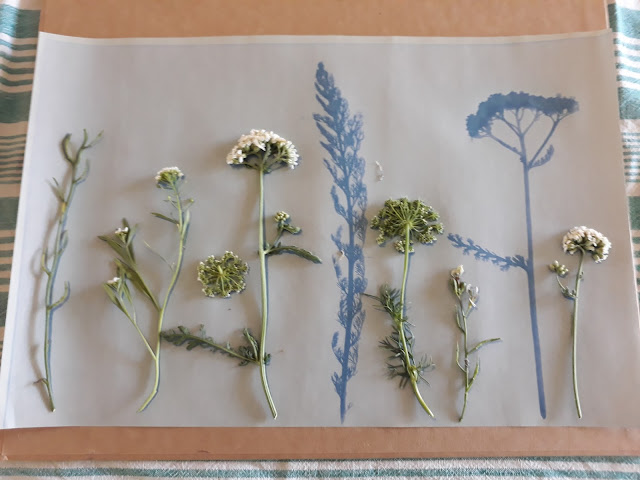


Snippets of my garden in a sunprint.

A magical process that results in stunning prints.
These stunning white on cyan-blue sunprints are technically known as cyanotypes. The process is actually a photographical one, capturing an image without a camera, that was developed by Sir John Herschel. It was a woman, botanist and pioneering photographer, named Anna Atkins, who began using the process, in the mid 19th Century, to record finely detailed botanical images of sea algaes and ferns. I would dearly love to spend time looking at every single page of her exquisite book, but this YouTube clip is the closest I could find to holding it in my own hands. Hers was the first book ever published exclusively with photographic images. How amazing!
The process of making these stunning prints is simple and oh so satisfying!

Gather sprigs of plant material from your garden.

Gather printmaking supplies ...
cyanotpye paper, thick piece of cardboard, perspex, water bath.

Lay cyanotype paper onto thick cardboard.
Sandwich plant material between the paper with clear perspex on top.

Lay out in sun for up to 5 minutes.

Carefully remove plant material to reveal beautiful prints.

Rinse the paper in a tub of water and watch as the prints fade to white.

Dry on a flat surface.
As the sunprint dries, the background will become a deeper and deeper cyan blue.
Here are two of the other sunprints I made:

Almost-finished rocket flowers.

Scattered dry umbels of Queen Anne's Lace.
There are many beautiful projects that can be made with these stunning sunprints. From simply framing your favourite print to using the gorgeous paper to make bookmarks, handmade cards, gift boxes or as wrapping paper. I would love to explore how to make these prints on fabric. How lovely would that be!
Sunprints are a simple and satisfying way to capture the botanical beauty of plants. I made my prints in the sunshine of a scorching hot Summer's day. Perfect for that kind of weather. I think the process could also be quite addictive too!!
Meg


