Showing posts with label recycling. Show all posts

Wednesday, 20 September 2017

Recycling Mobile Phones

So, a whizz-bang, you-beaut, brand new and very expensive mobile phone model was unveiled this week with much fanfare. It made the news here in Australia and I've no doubt there will be a lot of people queuing up to get one when it becomes available. After all, it's the latest must-have ... isn't it? 

All the brouhaha left me thinking though:  What happens to all the superseded, unwanted, left-by-the-wayside, broken & discarded mobile phones out there? As coincidence would have it, I had good reason to find out during the week because my hand-me-down and decidedly not trendy mobile phone broke and repair was not an option. 

According to this recent news editorial, Australians buy new mobile phones in their millions every year meaning there are more than a lot of discarded mobiles languishing somewhere. I can't even begin to fathom how many that would be worldwide! Given the plastics, metals and contaminants in all those phones, what is best to do with them?

When a mobile phone breaks and is beyond repair or when it's no longer useful (to anyone), it can be recycled. According to Planet Ark, up to 95% of the resources in a mobile phone can be recovered so it makes sense to recycle them. It's also really important that they don't end up in landfill because the harmful substances in them can leach into the environment. 


In Australia, unwanted mobile phones can be sent in to Mobile Muster (or they can be dropped off at designated collection points) or they can be donated to organisations such as those listed here. These are great alternatives to letting an unwanted phone languish in a drawer or sending it to landfill. We packaged up my broken phone and an ancient one too (yep, it had been hidden away in a drawer) and sent them off to be recycled. Less junk all round!

If you have a mobile phone collecting dust at your place, and you want to recycle it, all you need to do is print off a mailing label, attach it to a padded envelope or bag, pop your old mobile in and send it off. You can also pick up a reply paid satchel, like the ones we used, at participating Australia Post branches. No postage required!

As for my new mobile phone, I didn't go and pre-order that newfangled gadget and instead purchased a far less fashionable model within my limited budget. This was much to the consternation of the sales person who simply couldn't understand why I didn't want all the bells & whistles of more trendy models. I'm pretty sure he felt I was depriving myself of something. I knew this to be debt but I don't think he saw it that way!

Meg


Friday, 23 December 2016

Making Merry: Handmade Gifts for Christmas

Wrapped up in handmade gifts is the time, the love and the well-wishes of the crafter. Little handmade gifts have been slowly taking shape here over the last few months as I've endeavoured to finish projects for our dear ones. I wanted to make sweet and beautiful things, useful things, things which speak of nature and of caring for our Earth. 

A creamy knitted washcloth and a sweet bird stitched on a little drawstring bag.
(Bird design by the talented Melissa Wastney of tiny happy.)

A little hand-rolled beeswax candle that smells of honey.
(Beeswax sheets from Happy Flame.)

Hand stitched and home-sewn reusable Christmas sacks. A little  gift tag too!
(Repurposed cotton and calico bags, old salvaged doilies and last year's Christmas cards.)

Beside me in this merry making has been our boy. He's happily rolled beeswax sheets into candles, written words on bags for me to stitch over, repurposed used Christmas cards into gift tags and added all the extra sparkles needed with a good sprinkling of glitter! (Apparently, one can never have too much glitter!)

There is now only a little merry-making left to do. Today, we'll bake some lemon myrtle shortbreads using fragrant fresh leaves. We'll wrap and tie with ribbon the little gingery Christmas cakes we have made for our lovely neighbours and we'll hand-dip macadamia nuts in melted white chocolate for a Daddy who loves them.  We will honestly try not to sample too many of these goodies while making merry in the kitchen. It is important to taste test though, isn't it?

Meg


Thursday, 25 February 2016

Old fashioned milk

I spent the very early years of my life in a dairy farming region far to the north of where I live now. My memories are of rolling green hills, dirt roads, picking native raspberries with my cousins, the creek at the bottom of a steeply sloping paddock and, of course, cows!

We lived up the road from my aunt and uncle. They had a dairy which is long gone now even though they still live in the same house on the same land. My family didn't have a dairy but we did have a house cow, a black and white fressian, named Maggie. Although I don't remember milking her with my mother, I do remember the thick layer of cream that could be skimmed off with a spoon and the most delicious ice-cream that my mother made and set in battered old cake tins. I have a memory of the taste of that ice-cream but, as much as I try, I can't replicate it! No recipe for it can be found in any of my mother's well-used, splattered cookbooks and she can't remember how she did it either because she stopped making it when we left the area and no longer had a house cow.

I was thinking about all this the other day when I bought some milk. I am fussy about milk, a legacy of my early childhood no doubt. And not long ago, at a little bakery not far from where I live, I found some lovely full-cream, unhomogenised milk in glass bottles. Old-fashioned milk!


I bought two bottles of this milk, produced less than two hours away from the city where I live, and found it to be delicious and creamy! I love that it's available in glass bottles as well as the standard plastic milk bottle though they can't be collected, sterilised and reused as yet but they can be recycled. I thoroughly washed both of the bottles I bought and they are now in our fridge holding chilled water.

I haven't attempted to make ice-cream with this milk yet but I will soon. I wonder if it will bring me any closer to that taste of the long-ago ice-cream my mother used to make for us. I might also try setting my next batch of ice-cream in a battered, heart-shaped cake tin as that might help too!


Meg


Tuesday, 9 February 2016

A Calico Flour Bag Tote

Look what I found hanging up on one of the stalls at the markets yesterday. 


Calico Flour Bag tote from My Heart Beats Green stall.

A repurposed calico flour bag! Last week, I wrote about how I turned a 2kg calico flour bag into a pretty drawstring gift bag. This little tote is made by attaching a simple handle to a 5kg flour bag. The handles are made from another one of the bags that has been cut into strips.  Easy and effective!

The flour bags are made by the folk at My Heart Beats Green who make organic cotton garments here in Australia. They source the used flour bags from Geoff, who sells the flours and grains that come in these bags, at his own stall just a few metres away from where these bags hang for sale. 

This is a great idea that reduces waste and encourages repeated use of the calico bags. A little win for our Earth!

I wonder what else can be done with a calico flour bag? 

Meg


Wednesday, 13 January 2016

The Compost Balancing Act

It took me such a long time to make compost successfully! I'd have compost that didn't break down properly or I'd have a stinky, too-wet pile that I couldn't spread anywhere. Then, after lots of researching (any excuse to watch gardening shows and DVDs) and talking to other gardeners, I was finally able to create crumbly, sweet-smelling compost that nourishes my soil. The secret was balance!

Achieving balance in a compost heap or bin means that things have to be added to it in the right proportions. Too much green, fresh material (such as veggie peelings or fresh lawn clippings) means a smelly, overly-moist mess. Too much dry, brown matter (such as leaf litter or shredded newspaper) means it takes forever to break down and you have no compost when you need it. I was often adding way too much fresh, green plant material. Soggy!

Fresh green garden trimmings ready to add to our compost bins.

I have found, within our rotating bin system, that I can achieve balance by looking inside the bins more regularly, smelling the piles inside and adding more fresh green or dry brown material depending on the level of moisture and the "fragrance" of the heap. Typically, I will often find myself adding more dry brown plant matter like the wonderful crispy fallen leaves from our neighbour's amazing plane trees. These deciduous trees drop their crunchy, crackly dry leaves every Winter and we rake them up to add to our compost bins as we need them. 

Dry, brown leaves destined for our compost bins.

The other key part of creating lovely compost is aeration. For us, this means spinning our barrels very regularly. Regular rotation stops the plant matter mixture inside the barrels from compacting and keeps the microbes, who do all the work in breaking down the composting materials, lively and happy. And, when those microbes are happy, in a compost pile with not too much green and not too much brown plant material, they will reward you with beautiful compost that you can nourish your garden with.

Compost from one of our rotating bins. 

Composting is the ultimate in recycling. All the plant matter that we direct into our compost bins would otherwise go to landfill where its goodness would be wasted. Instead, once broken down in our composting bins, it feeds the soil in which we grow the plants that feed us. 

Do you make compost at your place? What sort of system do you have?

Meg


Sunday, 27 December 2015

Boxing Day Compost

While the post-Christmas discount sales tempt many at this time of year, we decided to compost instead! 

Outside, under a warm blue sky, we cleared the spent sunflowers and tired cucumber vines from our veggie patch. We then gently levelled the newly cleared patch ready for a layer of our own "homemade" compost. What used to be our waste; garden clippings, veggie scraps, dry leaves and shredded paper; had broken down into a rich, earthy compost in our rotating barrels. 


 Garden goodness from our composting barrels.

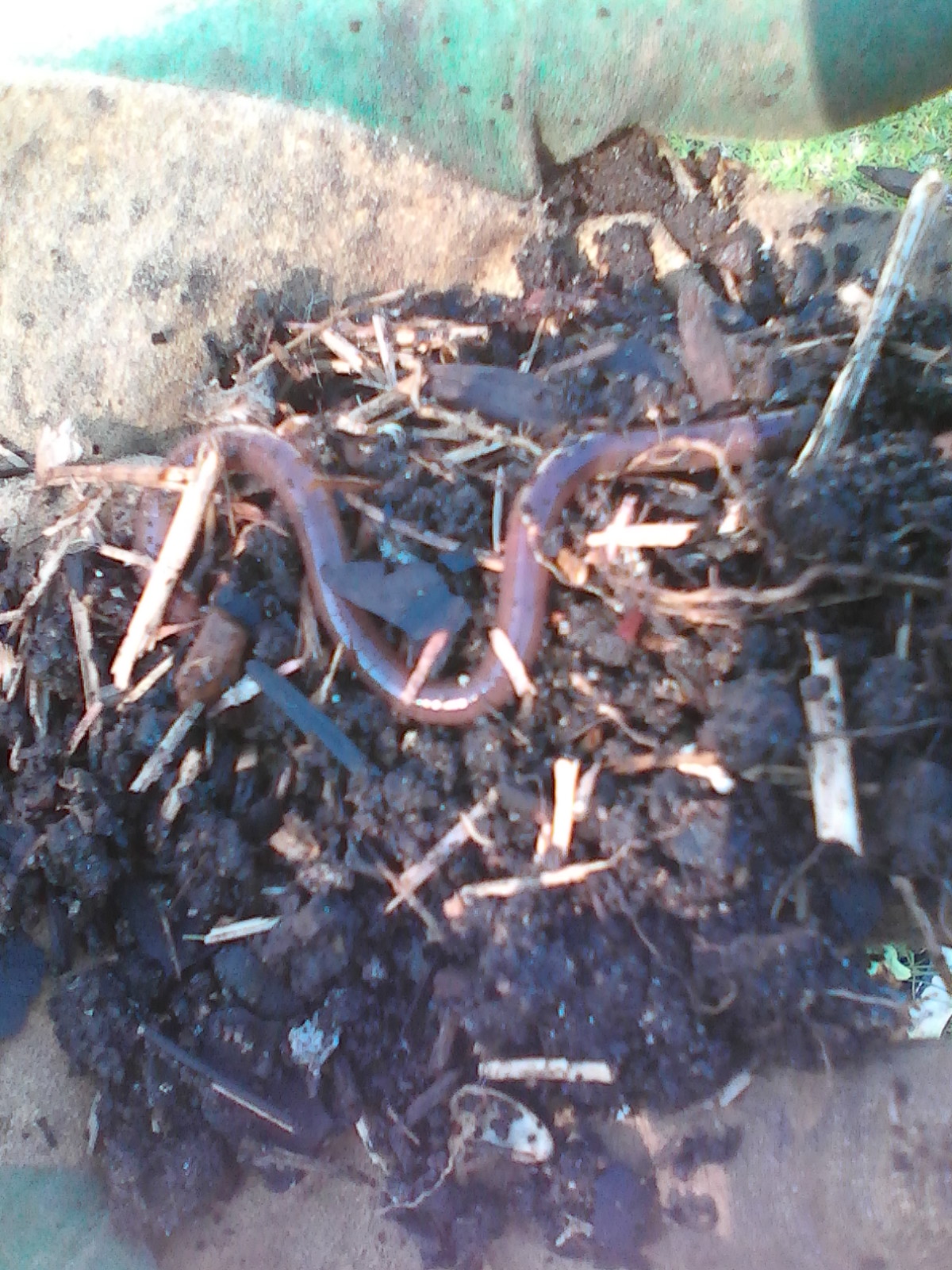
Scooping up handfuls, I knew it was ready for the garden; crumbly and earthy (not stinky) and full of goodness to feed our soil. We spread it over our veggie patch and around our mandarin tree too before "icing" it with a thin layer of lucerne mulch.  Now, we'll wait for the worms to do their work underground, incorporating the new compost, while the soil rests over the remainder of the summertime. 


One of our hardworking worms.

To complete the cycle and start making new compost, we filled one of our empty barrels with all the plant material we had cleared from our patch, crispy dry leaves and veggie peelings. We secured the lid and gave it a good spin to mix it all up and aerate it. In time, it will break down and make new compost for us to use in the garden.

Veggie patch scraps waiting to go into a composting barrel.

To me, the process of composting and feeding our soil is so much more satisfying than finding any Boxing Day bargain. It returns material to our Earth that would otherwise end up in landfill and costs us nothing. Do you compost at your place? Do you have any composting tips to share?


Thursday, 10 December 2015

Tiny Embroidered Bags

I always bring a craft project (or three) on holidays wherever we go. It feels wonderfully indulgent to have time to work on these projects at my leisure. 

Many months ago, I bought a stack of these tiny little white cotton bags from Reverse Garbage in Brisbane, a great place to find reclaimed and recyclable materials for all kinds of projects. As soon as I saw them, I knew exactly what I wanted to do with them!

The plain white cotton bag, washed and ironed and waiting for some embellishment!

Inspired by the work of Melissa Wastney, of Tiny Happy, I decided to make these into special, reusable bags. Whenever I have a small gift to give, I stitch a botanical motif onto the front of one of these bags using pretty threads from my embroidery stash.


Backstitch for the stem, pink french knots for the buds and lazy daisy stitch for the bloom.


Finished...a quick, easy and portable craft project.

These small embroidered bags sometimes hold soap or knitted washcloths or packages of flower seeds. This one became the pouch for a set of creamy pink, handmade beads for a dear and creative friend that I won't get to see this Christmas. I think she'll like it!