Showing posts with label permaculture. Show all posts

Wednesday, 1 November 2017

October Observations in the Garden

If you wandered very slowly through your garden, on its worn paths and to its edges, what would you notice? What would be the same and what would be different? What would be struggling and what would be thriving  in current conditions? What would be finishing, what would be ready to harvest and what would be just emerging? 

A lovely day lily in bloom. 

Since attending an Introduction to Permaculture course last year, I have continued to read and to learn more and to think...a lot! One book I have on loan from my local library at the moment is Rosemary Morrow's "Earth User's Guide to Permaculture (2nd ed.).  I have really enjoyed sections of this book which has been a bit easier to understand than the few other books I've managed to find. 

There is an emphasis on observation in this book with it identified as a key skill to develop in order to define problems, see possibilities, recognise patterns and consider relationships. So, what did I observe in the garden during the October that's just gone by? 

Plants
  • sweet peas are finished flowering and pods are forming
  • day lilies are coming in to bloom 
  • rose geranium growing too close to entrance of native bee hive
  • tiny zinnia seedlings have emerged in areas where I sprinkled them - less than one week to germinate 
  • self-seeded lettuce under mandarin
  • new growth on avocado tree
  • last two homegrown beetroots ready to harvest
  • cherry tomato plant in 3rd barrel smaller than the other two
  • plane tree branches covered in spring growth, branches spreading out near Grevillea Lollypop closest to the house
  • ripe blueberries in clusters mysteriously disappeared overnight
  • first Lebanese cucumbers are ready to pick
 A much smaller cherry tomato bush in the barrel on the right. Hmmm...

Zinnia seedlings germinated very quickly. 

Plane tree branches are crowding this grevillea. 

Garden Jobs:  collect sweet pea seeds when brown & dry, cut back rose geranium from hive entrance, thin out zinnias as needed, check soil in the 3rd wicking barrel and top up water if dry, cut back branches of plane trees on our side of fence, net the blueberries!


I need to net the blueberries!

Animals
  • native bees in rocket flowers, honey bees in salvia, both in alyssium
  • crow brought stick down to backyard birdbath, put it in the water there while it had a drink, picked it up again and flew off!
  • cockatoo with rocket seed pod up on verandah railing, using beak to rip open pod and eat seeds inside
  • Bluey (our resident blue-tongue) just peeking out from under boards at edge of front verandah garden, first sighting!
  • King Parrots and Pale-headed Rosellas feeding on flowers of larger red-flowering grevillea outside our bedroom. Unusual to see both these types of birds.
  • aphids on the roses
Garden Jobs:  lightly prune grevillea when finished flowering, allow rocket to self-seed in the garden so more grows for bees & cockatoos, squish aphids!


A photo of "Bluey", our resident Blue-tongue Lizard.
(This photo was taken a couple of years ago but he's still around...or one of his relatives is!)

We had quite a few storms and lots of lovely rain this past month but I can't tell you how much exactly because we don't have a rain gauge set up in the garden. Must remedy that! The rain and storms we've had made such a difference to the garden, seems as though everything grows a foot overnight after a good drenching. 


Good growth on these Canna Lilies.

Relationships: 
  • More and different birds came into the garden because it was really dry, before we had good rain. 
  • Lettuce self seeds under the mandarin tree because it provides some shade and protection from afternoon sun.
  • Aphids are attracted to new growth & rosebuds because they have lots of juicy sap that these little insects feed on.
  • Rain and storms triggered more vigorous growth in many of the plants in the garden. Here's a good explanation of why storms are good for plants.

First cucumbers and other delights from the garden!

Observing like this, as I wander around my garden, really focuses my attention, has me pondering things a bit more and looking for connections. It helps me to identify what needs doing, like squishing those aphids before they do any real damage to the roses or netting those blueberries so we actually get to eat some!

I wonder what my November observations will tell me?

Meg


Monday, 9 October 2017

Tricky Areas in my Garden

I think there must be tricky areas in every garden. Places where the soil is too moist or too dry, where soil is too shallow or barren, where there's too much sun or too much shade, where the land slopes considerably so the rain just runs off and areas under the cover of decks or verandahs that no rainfall can reach. So it is in my garden!


Here, within the boundary of our suburban home, there have been many challenges to overcome in the garden. First and foremost was the soil. Shale atop clay and rock was all we had to work with on our denuded, empty block when we bought it. The topsoil had been scraped away by the developer so there was no soil of any depth to sink a spade into. (In fact, we were lucky if we could sink half a spade in!)


The beginnings of our home on our suburban block.

The solution to this lack of deep, fertile soil continues as a work in progress. All the garden beds were constructed with "soil" carted in from the local landscaping supplier. Had I known then what I know now, I would've done a lot more to that "dirt" before I planted a single thing in it. (Hindsight is indeed a wonderful thing!) 


Compost = better soil!

The ongoing solution to this poor starting base has been to add as much organic matter to the soil as possible and to keep on building it up! Compost, castings and tea from our worm farm, seaweed solution, manures, rock minerals and mulches. Our soil is improving and so now more grows here. 


Mandarins, rocket, calendula, lavender and leek!

Another challenge here has been the south-westerly facing front yard. Many of the original plants I put in out the front, before I really knew much about gardening at all beyond the flowers I liked, shrivelled up in Summer heat. Gradually, native shrubs have replaced those plants that were unsuited to those hot, dry conditions. Now, whenever I see our gorgeous grevilleas in bloom, in reds and pinks and golds, I am reminded of all that I've learned about choosing the right plant for the position you are going to plant it in. The native birds are happy too!


Native Grevilleas replaced the standardised Gardenias in this garden bed. 
(Can you see the struggling Magnolia Little Gem between them?)

The pretty pink flowers on these Grevilleas.

The slope of our land has also presented challenges. Garden beds in the higher areas dry out much more quickly. I've tried to choose plants, like salvias, that don't mind these drier conditions once they are established in the garden beds at the 'top' of my garden. They are colourful, hardy and bring in the bees. Another slope was created when our block was "cut" to create the level pad for where the house was built. The solution for this long, narrow and rocky slope, that runs down to our Eastern boundary, was to plant a creeper that would cover it. Bauhinia corymbosa or the butterfly vine is fast-growing, hardy and has the most pretty pink flowers. 


The creeper that covers little rocky slope.
(The leaves from neighbouring trees fall, decompose & nourish the plants.)

It's beautiful pink flowers.

Along part of the back boundary, our neighbour planted a lillipilly hedge very close to the fence. The roots of this hedge have spread over into the garden bed we made on our side of the fence. They take up a lot of the moisture and nutrients from that soil making it very difficult to grow much in this area.


My wonderful wicking barrels.

My solution was to plant above the existing soil in wicking barrels. It only took me the better part of a decade to figure this out!! The lillipilly hedge provides some shade for these barrels in the hottest months of the year. When the neighbours cut the hedge back in Autumn, more light reaches the barrels in the cooler months. 

Each time I replenish the topmost layer of soil in these barrels, I spread out the "leftovers" on the garden bed around them. I've worked compost into this each time and over the past year a few things have started to spring up in between the barrels, namely self-seeded pumpkins and lettuce. (Can you see the little pumpkin plants in the photo above?) This year, I've sprinkled some Zinnia seeds in between the barrels too and am watching to see if they'll germinate. If they do,  they will add lots of colour to this area but also provide more Summer food for my little native bees who love to forage in Zinnia flowers.

I can now grow food & flowers in this area.


We are very lucky to have a long verandah that wraps around most of our home plus a wider rotunda that extends our living area outside. The garden beds underneath presented a real challenge though because they receive no rainfall. The soil can dry out very quickly in these sheltered garden beds.


Tough native gingers growing under our front verandah.


Both of these areas needed really tough plants. Under the front verandah, native gingers are growing. They tolerate the drier soil and hot Summer sun. They have lovely green strappy leaves and a flower spike covered in little white flowers. After the flowers, blue berries form that are very popular with native birds. They are also a bush tucker plant. 

Under the rotunda, and after much frustrating trial and error, I planted spider plants. They are gradually multiplying in this area and slowly filling it in. They have strappy variegated foliage, like to dry out between waterings and are easily propagated by division.  Although a common houseplant, they can also be grown outside. I am also testing out other "free" plants, like Agapanthus, as I divide them from existing garden plantings. It's cheaper that way!


 Spider plants growing  in the garden under our rotunda.

So, these have been the major challenges in our garden and the solutions we've arrived at ... some after much trial and error. What challenges has your garden presented and how have you overcome them?

Meg


Monday, 26 June 2017

Earth Care at our Place

There is much about sustainability "swirling" around us all the time now as our world grapples with environmental challenges, not the least of which is climate change. Just recently here, there has been the popular television program, ABC TV's War on Waste, media reporting of imminent energy price hikes in some Australian states, the release of the independent Finkel Review into the future security of the National Electricity Market, the controversy surrounding the proposed Carmichael Coal Mine in Queensland's Galilee Basin, widespread coral bleaching on the Great Barrier Reef and so on ... 


If you are anything like me, sometimes all this can be overwhelming and can leave you wondering, "What can I do about all of this?" "Will anything I do make a difference?" The answer to those questions, for me, lies in one of Permaculture's key ethics. Maddy Harland, in an article for the magazine Permaculture (Vol. 82, Winter 2014)  wrote "Earth Care ... involves many decisions...we can make choices about what and how we consume and conserve." I think the choices we make as individuals count, I think they merge with the choices of others, like Fiona and Cheryl and Morag and Tammy, to create ripples for change in the world around us. 

So, here are some of the choices we make at our place. Did we make these changes overnight? No. Is there more we could do? Yes. But a beginning is a start, isn't it!

For the House ... 


Solar panels and solar hot water on our roof.
(We make a conscious effort to use appliances like wash machine in daylight hours.)

We collect rainwater from our roof.
(We have this small tank and a much larger one under our house.)

In the kitchen .... 


We grow and eat some of our own food.
(Reduces the food miles significantly.)

Healthy, wholesome meals made from scratch in our kitchen.
(Meat-free meals appear on our table regularly too.)

Reusable storage containers, pockets, covers and beeswax wraps.
(I no longer need to buy plastic kitchen wrap!)


Buying in bulk helps reduce packaging that comes into our home.
(Stored in good quality, air tight containers.)

Fruit and vegetable scraps go into our worm farm.
(Significantly reduces waste and returns goodness to the soil.)


In the Laundry & Bathroom ...


 The cleaning products and hand knitted washcloths we use.
(This is not a sponsored photo or post, simply the products we use.)

I buy this in bulk box of 48 double length rolls of 100% recycled toilet paper.
(Again, this is not a sponsored photo or post, simply a product we use.)

 Sunshine dries our washing.
(We have a line under the house and airing racks for wet days.)

On Our Bodies ...

Sewing some of our own clothes.
(A new skill I'm learning!)


A few simple products for skin and hair.
(Soap, coconut oil as moisturiser & apple cider vinegar as hair conditioner.)

Sourcing some pre-loved clothes from op-shops.
(I love this new-to-me top & wear it often.)

In the Garden ...

Our garden is a haven for wildlife like bees, lizards, birds and more... 
(We grow some native plants, have bird baths for water.)

We make compost from garden trimmings.
(This compost feeds our soil rather than garden waste going to landfill.)

Our garden prunings become mulch which feeds and protects our soil.
(Less waste destined for landfill.)


Handweeding instead of using chemicals.
(Fewer chemicals, that can adversely affect human & animal health, in the environment.)


Out and about ...

Reusable shopping bags and produce bags.
(Significantly reduces single-use plastic that comes into our home.)

One of our reusable water bottles. 
(We have stainless steel straws too in case we get milkshakes!)


We visit & borrow often from our local library.
(Books like this one broaden our knowledge & give us ideas.)

We spend time outside, soaking up and getting to know nature, as often as possible.
("We cannot protect something we do not love, we cannot love what we do not know.")
~ Richard Louv

You may do similar things at your place or you may do things differently. What we do here is by no means an exhaustive list (Far from it!). In the spirit of creating and spreading ripples, I hope you'll have ideas of your own that you can share. I'd love to know what you do at your place.

Happy Monday to you all.
Meg


Saturday, 29 April 2017

Making More Mulch

Laying down mulch over the soil in a garden has many benefits but it can be quite expensive if you have to buy it in regularly to cover a large area. The solution to cutting down that expense is to grow some of your own mulches.

Sugar cane mulch helps to protect the soil around seedlings like this little lettuce.

At our place, we have regularly used (and had to buy) sugar cane and lucerne mulches for our garden beds and veggie patch plus a coarser bark for laying down around native plants. We are hoping to cut down on how much of this mulch we need to buy, especially for the garden beds where shrubs and flowers are the predominate plantings. We are going to grow and make some of our own mulch instead!

The long, dry leaves of lemongrass laid around the base of a native raspberry plant.

I learnt a lot more about plants that I can grow for mulches at the Introduction to Permaculture course I completed in at the City Farm recently. Our teacher for this course, Morag Gamble, has this great list of plants you can grow as/for mulch over on her blog, Our Permaculture Life. At our place, in our suburban garden, we've chosen to plant more lemongrass and to start growing Canna Lily (Queensland Arrowroot variety) to increase the amount of our own mulch available for use in our garden.

One of many newly planted lemongrasses in our garden.

Lemongrass and Canna Lily grow quite abundantly in our climate so they are very suitable as "chop and drop" mulches, where you simply cut back the plants and let the leaves/stems fall to cover the soil. 

A new Canna Lily leaf emerges just weeks after planting divided rhizomes.

We also have an abundance of prunings, from the shrubs that grow well in our garden, at various times of the year. To make better use of these for mulch, we decided to invest in a little mulching machine. We used some gift cards we had been given by family last Christmas to put towards the cost of our new mulcher. 

Our new mulching machine.

By growing more plants for mulches and by putting suitable garden clippings through our little mulcher, we should save some money and also make better use of the organic material our own garden supplies us with. 

Do you grow plants for mulch in your garden?

Meg


Monday, 17 April 2017

The Source of Chocolate

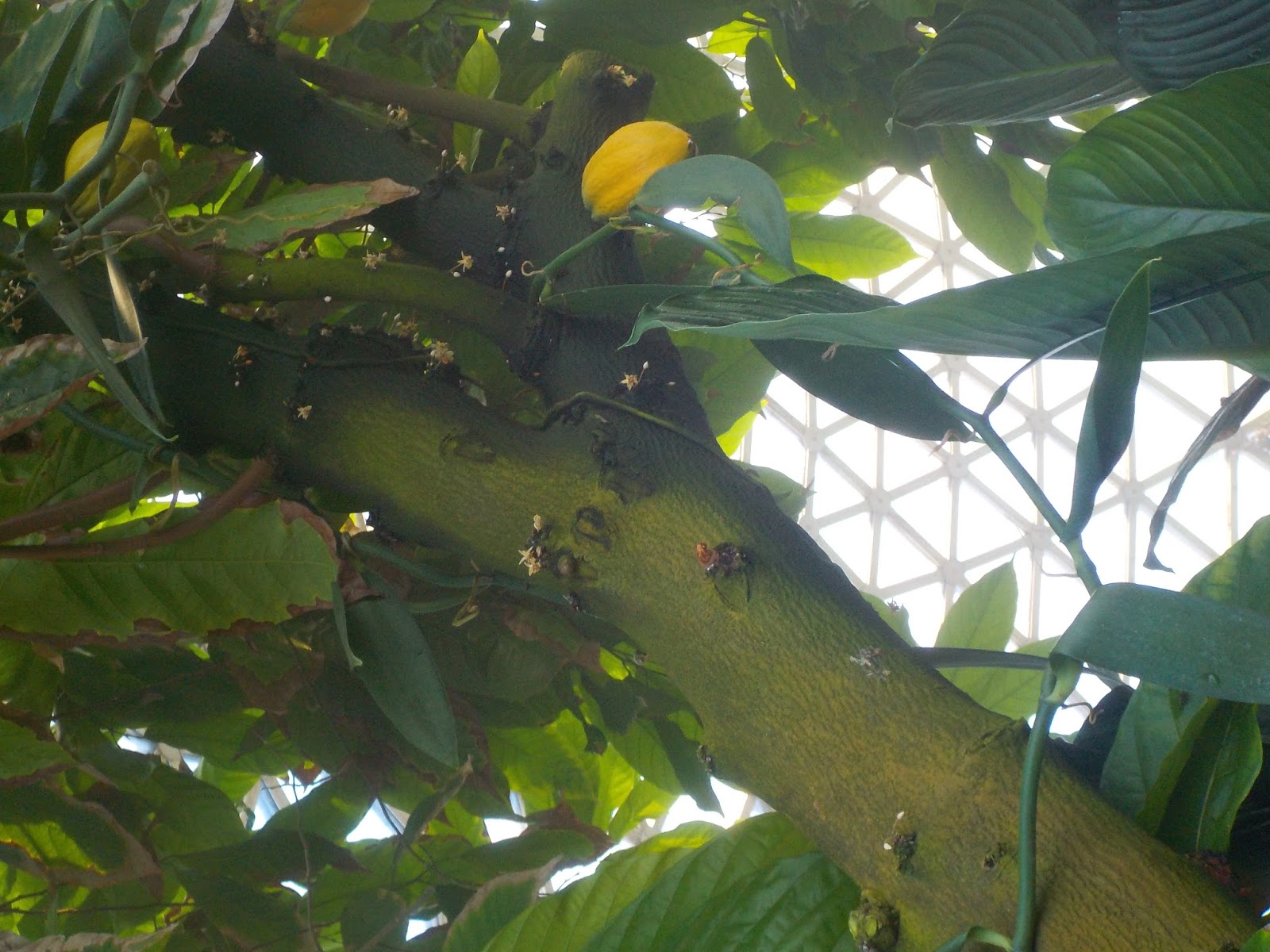
From the Amazonian rainforest comes the tree that gives us the raw ingredient from which we make chocolate, one of the world's most beloved foods. Its scientific name (Theobroma cocao) is loosely translated, from its Greek roots, as "food of the gods" (Theos meaning God & Bromas meaning food). Chocolate lovers the world over would surely agree it's an aptly named tree!

 Ripe yellow pods on a Chocolate Tree.
(Theobroma cocao)

On a recent trip to my city's Botanic Gardens, we found a Chocolate Tree growing in the warm and humid environment of the Garden's tropical dome. Inside the ripe, yellow pods, are the seeds (beans) which, once processed, will yield the nibs from which cocoa liquor  is made. This liquor (which contains cocoa mass and cocoa butter) is the basis for making the chocolate so many of us love.

The tree's sign in the Mt. Coot-tha Botanic Gardens, Brisbane.

The commercial production of cocao beans is very labour intensive. Growing and caring for the trees, harvesting and the early stages of processing the pods and beans, is done by hand. For example, the ripe pods are picked and opened by hand, the beans inside are scooped out by hand & dried beans are sorted by hand. Much of the world's cocoa beans are produced on small family farms in West Africa, where the farmers live well below the global poverty line of less than $1.90 per day. To me, that's a sobering "cut-off point"  given that a single chocolate bar can cost more than that here in Australia.

Recently, I have started learning about Permaculture & have been considering simple, practical ways/actions in which to integrate its three ethics of Earth Care, People Care & Fair Shares at our place. Choosing fair trade chocolate would make sense because it encourages the ethical growing and processing of cocoa beans and the provision of a living wage to farmers, farm workers and their families.  

Delicious dark chocolate ... the end product we buy.

Considering the source/production/impacts of the foods we buy, such as the chocolate that is made from the beans of these Chocolate Trees, can certainly raise some questions, issues and ethical dilemmas sometimes. 

Meg


Monday, 10 April 2017

A Peek into Permaculture: Producing Food at Home
There is something quite wonderful about a garden that grows food. For me, it is a joy that is made tangible in the:

*   "tucking in" of seeds full of potential;
*   tiny seedlings that emerge in nourishing soils;
*   edible greens, fattening pods, ripening fruits and expanding tubers;
*   baskets laden with food harvested not far from our very own back door; 
*   making of meals using some of our very own produce ...
&  it's in the sharing of excess with family, friends, neighbours and strangers.

Ripening mandarins on our tree beginning to blush orange.

But growing food in our own garden is so much more than that. It is about:

*   locally grown goodness (as local as it gets);
*   healthy food produced without chemicals;
*   fresh food tasted and cooked and appreciated just minutes after it's been harvested;
*   precious seeds saved and shared ...
&  it's about a measure of self-reliance.

Fresh, young silverbeet growing happily among the flowers.

I have not read much of the work of Bill Mollison, co-originator of Permaculture along with David Holmgren, but these wise words of his were echoing in my mind as I planted the first of this Autumn's seedlings:

"The greatest change we need to make is from consumption to production,
even if on a small scale in our own gardens ..."

Just planted ... Perpetual Spinach, Tuscan Kale and Silverbeet seedlings in my garden.

The planting out of seedlings, a seemingly simple act of gardening, is so much more than that.  Perhaps, that is why growing some of our own food fills me with such happiness.

Do you grow some of your own food at home too? 

Meg