
Clustered together, on the exquisite umbels of Queen Anne's Lace, are hundreds of tiny white flowers. What a collective impression they make! Each
large and full flowerhead is reminiscent of frilly white lace.
According to legend, delicate white lace tatted by Queen Anne of
England became the flowers of this beautiful plant. A very regal
beginning!

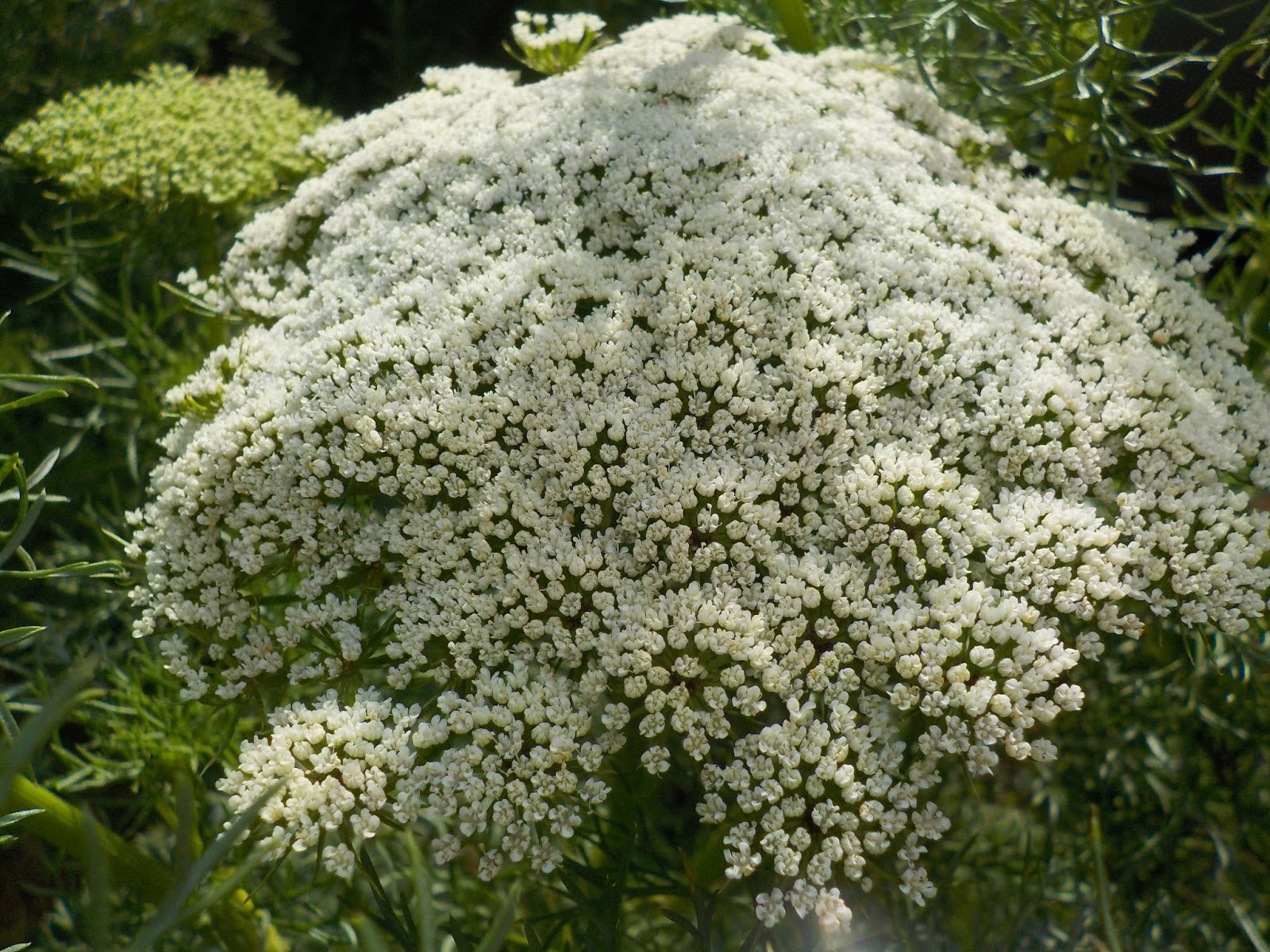


One of the things I love about this old-world plant is the way in which the flowers bloom. At first, each umbel is closed up while tiny buds form. Then, each umbel's "spokes" gradually open out until the flowers are in full bloom, covered in a mass of white "lace". After the flowers are spent, the "spokes" of each umbel become dry and brown and close in on themselves again. So much like opening and closing umbrellas!


Queen Anne's Lace is known by another name too, Wild Carrot (Daucus Carota). As a member of the carrot family, its young roots are edible though I have never tried them (and one has to be careful as I've read that certain relatives of Queen Anne's Lace are poisonous) as I grow it just for its beautiful blooms and the beneficial insects it invites into the garden.
I planted just two little seedlings of Queen Anne's Lace in my garden a couple of years ago. Now, thanks to the ease with which the seeds disperse on the wind from those dry, closed-up umbels, I have dozens of plants and many white, lacy flowers to enjoy each Spring.
I planted just two little seedlings of Queen Anne's Lace in my garden a couple of years ago. Now, thanks to the ease with which the seeds disperse on the wind from those dry, closed-up umbels, I have dozens of plants and many white, lacy flowers to enjoy each Spring.
Do you grow Queen Anne's Lace too?
Meg

