Monday, 7 November 2016

Butterflies and a Book

Butterflies are such captivating creatures. Flashes of colour from beautiful wings that beat rapidly yet make no sound or vibration that we can hear or feel. A life cycle that involves a metamorphisis of such magical change that it leaves children and adults alike enchanted. Their brief lifetimes that serve to remind us, should we contemplate it, of the shortness and impermanence of our own lives.

 The butterfly counts not months, but moments, and has time enough.
                              
                                                                                                                                ~ Tagore

This Spring, we have had many beautiful butterflies visiting our garden. From large-winged Orchard Swallowtails coming to lay their eggs on our Mandarin tree to pesky Cabbage Whites stopping in at the last of the kale. And yesterday, these two sweet little butterflies flittered and fluttered here for a while and stopped, just long enough, for me to take their photographs (after cheekily flying away again and again whenever I approached with my camera).

 A pretty butterfly among pretty pink blossoms. 

 A resting butterfly on the leaves of lettuce.

Matching my photographs to the much more professional ones of Densey Clyne, in our favourite butterfly book, Attracting Butterflies to Your Garden, we found out that these two winged beauties are the Caper White (Belonois java teutonia) and the Meadow Argus (Junonia villida) respectively. 

A useful and informative book filled with clear photos and profiles of many butterflies.

We have found that books like these, with clear photographs and easy-to-understand profiles, have been perfect for sharing with our boy and for learning more together about many of the amazing creatures that visit our garden or call it home. 

Out in the garden, in the early morning sun of yesterday, it was lovely to be in the company of butterflies.

Meg


Monday, 31 October 2016

A Queen's Lace

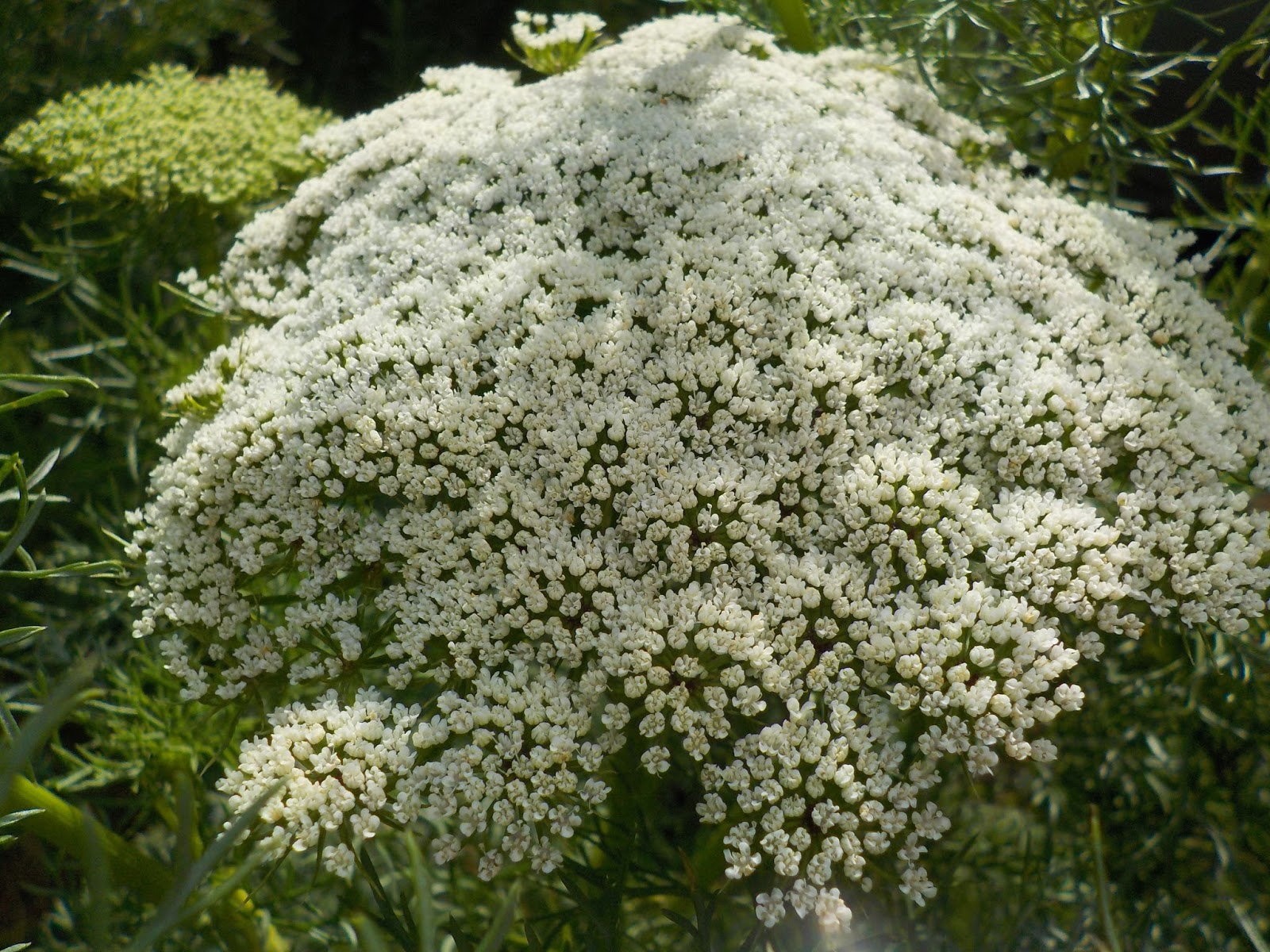
Clustered together, on the exquisite umbels of Queen Anne's Lace, are hundreds of tiny white flowers. What a collective impression they make! Each large and full flowerhead is reminiscent of frilly white lace. According to legend,  delicate white lace tatted by Queen Anne of England became the flowers of this beautiful plant. A very regal beginning!


Oh, so fine! The delicate, frilly flowerheads of Queen Anne's Lace.

One of the things I love about this old-world plant is the way in which the flowers bloom. At first, each umbel is closed up while tiny buds form. Then, each umbel's "spokes" gradually open out until the flowers are in full bloom, covered in a mass of white "lace". After the flowers are spent, the "spokes" of each umbel become dry and brown and close in on themselves again. So much like opening and closing umbrellas!


The beautiful umbels of Queen Anne's Lace.

Queen Anne's Lace is known by another name too, Wild Carrot (Daucus Carota). As a member of the carrot family, its young roots are edible though I have never tried them (and one has to be careful as I've read that certain relatives of Queen Anne's Lace are poisonous) as I grow it just for its beautiful blooms and the beneficial insects it invites into the garden. 

I planted just two little seedlings of Queen Anne's Lace in my garden a couple of years ago. Now, thanks to the ease with which the seeds disperse on the wind from those dry, closed-up umbels, I have dozens of plants and many white, lacy flowers to enjoy each Spring. 

Do you grow Queen Anne's Lace too?

Meg 


Friday, 21 October 2016

Hooray for Hippies!

A row of beautiful, bold and bright red buds have burst into bloom in our garden. They are simply stunning!

 A red row in the morning sunlight.

 A cluster of buds.

 Hippeastrum blooms up close.

Similar to those in Selina's garden, but with streaks of white upon their deep red petals, they are the flowers of the gorgeous Hippeastrum lily (or Hippies, for short). The bulbs which give rise to these amazing flowers were given to me by my sweet mother-in-law, coming from her garden to mine. What a gift! 

I planted my row of bulbs just out from the verandah above, in a position where they receive full morning sunlight and afternoon shade. The soil they are planted in is deep but not overly rich. They don't get a lot of water there, just whatever they soak up from the rain and the odd watering when I'm refilling the birdbath.

Hippies only flower for a few short weeks, but the opening of their striking red blooms is much anticipated every year. Hooray for Hippies!

Meg

p.s. If you'd like to see some of the different Hippeastrum blooms or grow some Hippies in your garden, this link has some helpful information.